
Nicaragua’s most bizarre bucket-list activity started with a guy sliding down a volcano on a mini-fridge
Sliding down an active volcano on a piece of plywood sounds like the kind of thing you’d back out of at the last second.
I didn’t.
Cerro Negro sits just outside León in western Nicaragua, and it’s become one of the strangest bucket-list activities in Central America for a very simple reason: someone got bored enough to try sliding down it on a mini-fridge first.
Seriously.
Before there was a proper board or a company running daily tours, there was just one guy testing whatever he could find to survive a run down a few hundred feet of loose volcanic ash. A mattress. A door. That mini-fridge. Eventually, a reinforced plywood board with a metal backing won.
How a guy with a mini-fridge invented an extreme sport
Volcano boarding wasn’t dreamed up by some outdoor brand’s marketing team.
It came from Daryn Webb, an Australian who opened León’s Bigfoot Hostel around 2004 and started experimenting with what could survive a trip down Cerro Negro’s ash slope. The mattress and the fridge door didn’t hold up. What did was a plywood board with a metal underside and a rope for steering, and Bigfoot ran the first commercial tours not long after.
Twenty-plus years later, it’s still basically the same setup. Somehow that’s part of the appeal — this isn’t a slick, over-produced adventure park, it’s a hostel owner’s fridge-testing experiment that just never stopped.
This volcano is younger than you’d think
Cerro Negro isn’t some ancient, weathered peak.
It’s the youngest volcano in Central America, born in an eruption that started in April 1850. It’s erupted more than 20 times since then and last blew in 1999, which means the cone you’re climbing is still, technically, an active volcano and not some decommissioned tourist prop.
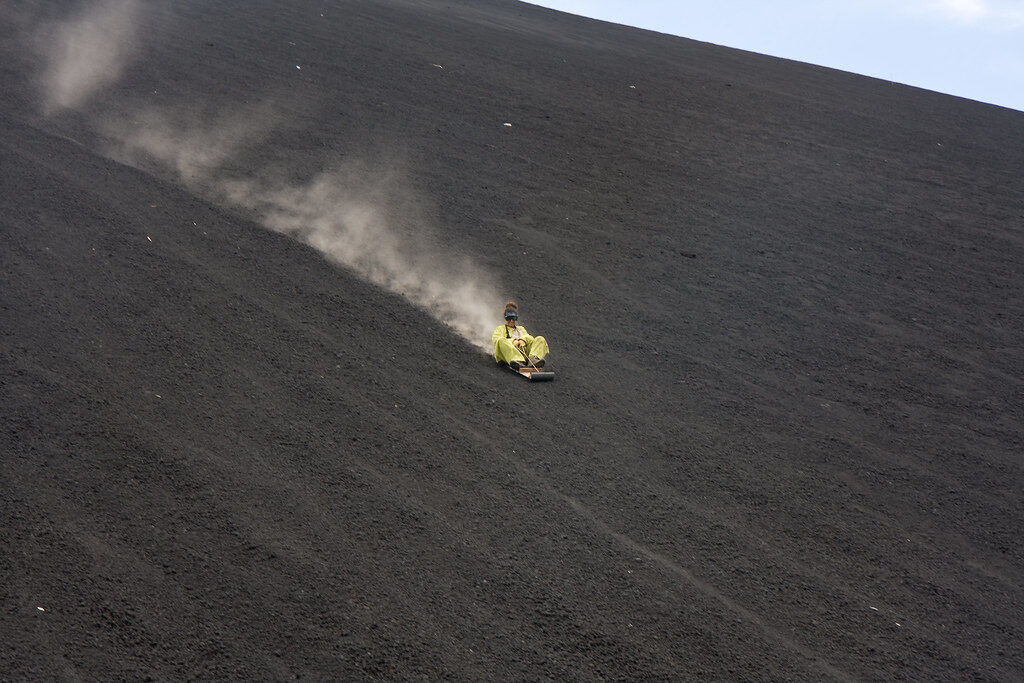
That’s also why the descent actually works. Cerro Negro’s eruptions dumped loose black ash and rock down one side of the roughly 250-meter (820-foot) cone, and that’s the exact texture a board needs to slide instead of just stopping.
The hike up takes longer than the ride down
I’ve hiked a few of Central America’s volcanoes at this point, including Pacaya in Guatemala and Santa Ana in El Salvador, and Cerro Negro is the odd one out.
Most volcano hikes reward you with a long, scenic climb and maybe some steam venting from a crater. Cerro Negro’s hike is short, roughly 45 minutes of loose gravel and sand from the parking area, with zero shade and wind that will absolutely try to take your hat with it.
The climb itself isn’t technically hard. It’s just exposed, hot, and a little absurd, especially once you’re also carrying a wooden board that acts like a sail in the wind. Local porters will carry it up for around $5, and I’d argue that’s the best few dollars you’ll spend all day.
The world record isn’t even the wildest thing that’s happened on this mountain
Volcano boarders top out around 43 mph (69 km/h) on a normal run, and the outer edge of what anyone has managed on a board sits at roughly 54 mph (87 km/h).
That’s fast. It’s not the craziest number attached to this mountain.
In 2002, French downhill cyclist Éric Barone rode a modified mountain bike down Cerro Negro’s slope and hit 107 mph before his front fork snapped off mid-run. He tumbled several hundred feet, broke six ribs, tore both shoulders, and needed years to fully recover. Guinness World Records still lists it as the record for the highest downhill speed on a bicycle on soil.
I did not attempt to beat that. I would not recommend attempting to beat that.
What it’s actually like once you’re strapped in
You gear up at the top: a protective jumpsuit, goggles, and a bandana or buff over your nose and mouth, because loose volcanic debris flies everywhere once you’re moving. Your backpack goes on your front, under the suit, which makes everyone in the group look a little bit pregnant.
Keep the goggles on the entire way down. I lifted mine for one second to check my GoPro angle, caught volcanic grit in my eye, and spent the next day with an irritated, scratchy eye for my trouble. Lesson learned the hard way, and an entirely avoidable one.
You sit rather than stand, and your feet do the steering: dig your heels in to slow down, shift your weight to speed up. Was it scary? Not really, at least not for me, since you actually have more control over your speed than you’d expect.
The ride down is over in a couple of minutes, which feels almost unfair after 45 minutes of hiking uphill in the sun. But that’s kind of the point. You earn it.
Would I actually recommend it?
Yes, without hesitation, if you’re spending any time in León.
It’s not some heart-stopping, near-death experience. It’s dusty, sweaty, a little ridiculous, and one of the only activities on earth where the safety briefing includes instructions on how to steer with your feet down the side of an active volcano. Book it through a tour that handles transportation, board, and protective gear — this is the exact Cerro Negro volcano boarding tour I did, and it sorts out the annoying logistics so you can just show up and slide.
Would I do it again? Absolutely. Would I try to beat Éric Barone’s record? Absolutely not.
Would you slide down an active volcano on a piece of plywood, or is this exactly the kind of bucket-list item you’d happily skip? Either way, at least now you know it started with a mini-fridge.
