
Places Americans Think Are ‘Too Dangerous’—But Expats Know Are Totally Livable
If you’ve ever told someone you’re thinking about moving abroad and they replied with, “Isn’t it dangerous there?”…congrats, you’ve met The Average American News Consumer™.
A lot of places get labeled “too dangerous” based on headlines, old reputations, or that one story your uncle saw on cable ten years ago. Meanwhile, expats are out here grocery shopping, walking the dog, and paying electricity bills in those exact places like it’s no big deal.
Let’s talk about a few spots that sound scary to Americans but are, in reality, very livable if you use your brain and basic street smarts.
Your Fear Radar Is Tuned to Headlines, Not Actual Risk
Quick reality check: the U.S. is not exactly the global gold standard for safety.
Recent data puts the U.S. homicide rate around 5–6 per 100,000 people, while many European countries sit around 1 or lower. Our World in Data
In other words, a lot of Americans are sitting in cities with high violence rates talking about how “dangerous” other countries are…which is a little ironic.
Add in:
- Sensational U.S. news coverage of “crime abroad.”
- Old reputations that never got updated.
- Travel advisories that people half-read and then wildly misinterpret.
And suddenly everywhere outside your ZIP code sounds like a war zone.
So instead of vibes, let’s look at a few specific places where perception and reality are wildly out of sync.
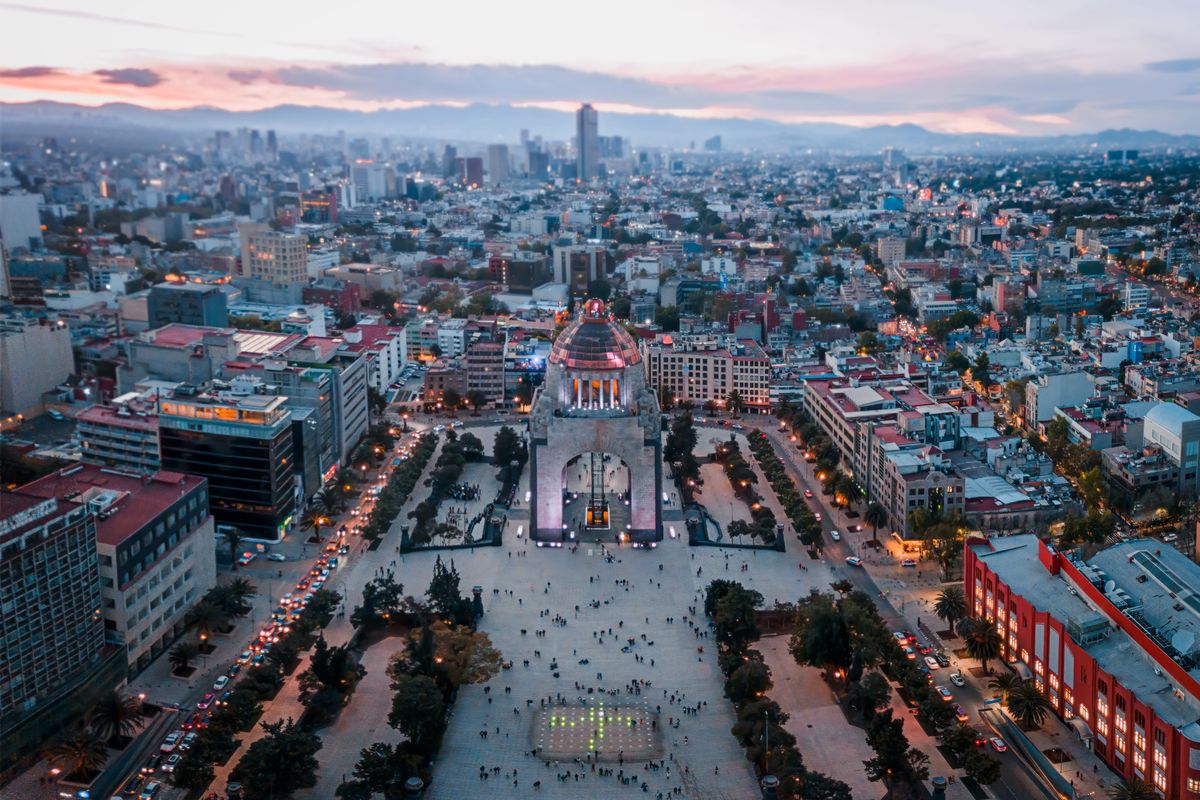
Mexico City: Headlines vs Actual Numbers
Say “Mexico City” in a U.S. group chat and at least one person will act like you’re volunteering as tribute.
Is there crime? Absolutely. It’s a giant capital city. But the numbers do not match the “instant kidnapping” energy Americans project onto it.
In fact, recent stats show Mexico City’s murder rate is around 9–10 per 100,000, which is lower than Washington, D.C.’s, where the rate hit about 27.5 per 100,000 in 2024. The Guardian
Inside Mexico, Mexico City also looks relatively good compared to more dangerous states where cartel violence is concentrated. It has:
- Heavier police presence
- More social services
- Better infrastructure and surveillance than many smaller cities
Is it crime-free? No. But “CDMX” to expats often looks like:
- Walkable neighborhoods
- Cafés with remote workers glued to their laptops
- People Ubering home from dinner like it’s any other big city on earth
The risk is not zero, but it’s nowhere near “everyone who goes disappears into the cartel” territory.
👉 Want the official read? Check the U.S. State Department page for Mexico.
Medellín, Colombia: Former Narco Capital, Current Real-Life City
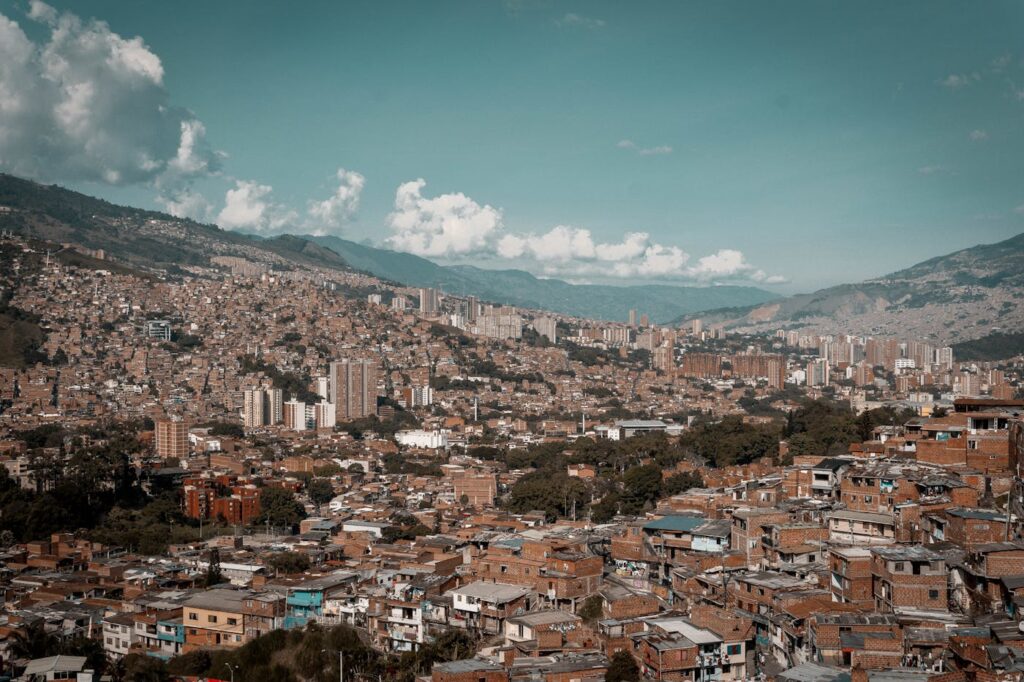
Medellín’s PR problem is simple: people’s brains are still stuck in the Pablo Escobar Netflix era.
Reality in 2025: homicide rates in Medellín and other Colombian cities have dropped dramatically over the past decade. One regional analysis notes that cities like Medellín and Cali, once among the most violent in the world, have “improved markedly.” Americas Quarterly
Another comparison points out that Bogotá and Medellín now have lower violent crime rates than some major U.S. cities like Indianapolis, St. Louis, or Baltimore. WhereNext Travel
Are there still safety issues? Yes:
- Certain neighborhoods are no-go zones.
- Petty theft, phone snatching, and scams exist (shocking, I know, in a city of 2.5+ million people).
- You don’t walk around flashing a brand-new iPhone at 2 a.m.
But the expat version of Medellín is:
- Coworking spaces in El Poblado and Laureles
- Packed restaurants and cafés
- People jogging, walking dogs, and living extremely normal lives
It’s not “danger-free.” It is absolutely livable with common sense and basic research.
👉 For the official context, read the U.S. State Department info for Colombia.
Türkiye (Turkey): Scarier on Paper Than On the Street
Turkey gets a dramatic reputation in U.S. media because of terrorism headlines, politics, and its location on the map. The U.S. currently rates it as Level 2: Exercise Increased Caution, with “do not travel” warnings for a few specific border regions near Syria. Travel State+1
Here’s the part no one in your Facebook comment section mentions:
- One comparative analysis claims you are 7–9 times safer in Turkey than in the U.S., with violent crime about 78% worse in the U.S. and overall crime per 1,000 people about 9 times higher in the U.S. Turkey Travel Planner
Does that mean Istanbul is a crime-free utopia? No. It means:
- You watch your bag in crowded tourist areas (like you would in Paris or Rome). GOV.UK
- You avoid specific high-risk regions that advisories explicitly name (looking at you, Syrian border). Travel State+1
Most expats and long-stay travelers in Istanbul, Izmir, or Antalya will tell you their day-to-day life feels no more dangerous than any other big European city, and in some ways safer than several U.S. cities.
👉 See the Turkey travel advisory for official details and restricted areas.
Albania: Mafia Headlines vs Tourist Reality
Albania headlines are wild. One day it’s “Europe’s Maldives” with turquoise water and cheap pints, the next it’s “mafia state with shadowy crime networks.” Both things can be true at the same time…and still not mean tourists are doomed. The Sun

Zoom out:
- Multiple safety overviews describe Albania as generally safe, with low violent crime and problems mostly centered on petty theft and road safety. World Nomads+1
- One 2024 crime index even notes Albania’s score is roughly similar to Canada’s. World Nomads
Tourism numbers keep climbing into the millions, and most visitors report:
- Feeling safe walking around coastal towns and Tirana’s central areas at night
- Biggest annoyances: pickpockets, aggressive driving, and the occasional sketchy taxi, not violent attacks BEETAXI+1
Does organized crime exist? Yes. Does that automatically translate to “unsafe for regular people buying groceries and going to the beach”? Not really. Most of that activity is invisible to tourists.
👉 For a solid overview, check the Albania country information page from the U.S. State Department.
Big Picture: How to Sort Real Risk From ‘My Mom Saw a Documentary Once’
If you’re nervous but curious, here’s how to sanity-check the fear.
1. Look at actual numbers, not vibes
Compare homicide rates and crime stats from credible sources, and remember the U.S. baseline is not “super safe.” Our World in Data+1
2. Read the full travel advisory
Not just the headline. Is the whole country dangerous, or just specific regions? Are we talking terrorism risk, petty theft, political protests, or something else? Travel State+1
3. Zoom in on neighborhoods
Cities are not monoliths. Some districts are expat-heavy, café-filled, and feel very chill. Others? Hard pass. This is true in Chicago and Medellín, New Orleans and Mexico City.
4. Talk to people actually living there
Expats will absolutely tell you:
- Which areas feel safe to walk at night
- Which bus routes to avoid
- What a realistic day-to-day feels like
5. Accept that “safe” is a spectrum, not a switch
No place is 100% safe, including the U.S. The question is not “Is there any risk?” but “Is the risk manageable and worth it for the life I want?”
Bottom line:
A lot of places Americans slap the “too dangerous” label on are objectively safer than several U.S. cities, especially once you look at violent crime and gun violence. That doesn’t mean you throw caution out the window. It does mean you should stop letting half-remembered news clips decide your whole life for you.
Do the homework. Read the numbers. Listen to people who actually live there. And then decide if the risk is acceptable for you—not for your aunt who hasn’t left her county in 20 years.
